
The 5S method: an organised workplace that makes the job easier
How often during a shift does someone search for a tool, move material out of the way or check whether a part on the bench has passed inspection? These interruptions soon become routine. Each one may be brief, but they happen every day, across many workstations.
5S helps organise the workplace so that what people need is available, status is clear and deviations are easy to spot. The benefit shows up when employees can do their work with less searching, walking, bending and uncertainty.
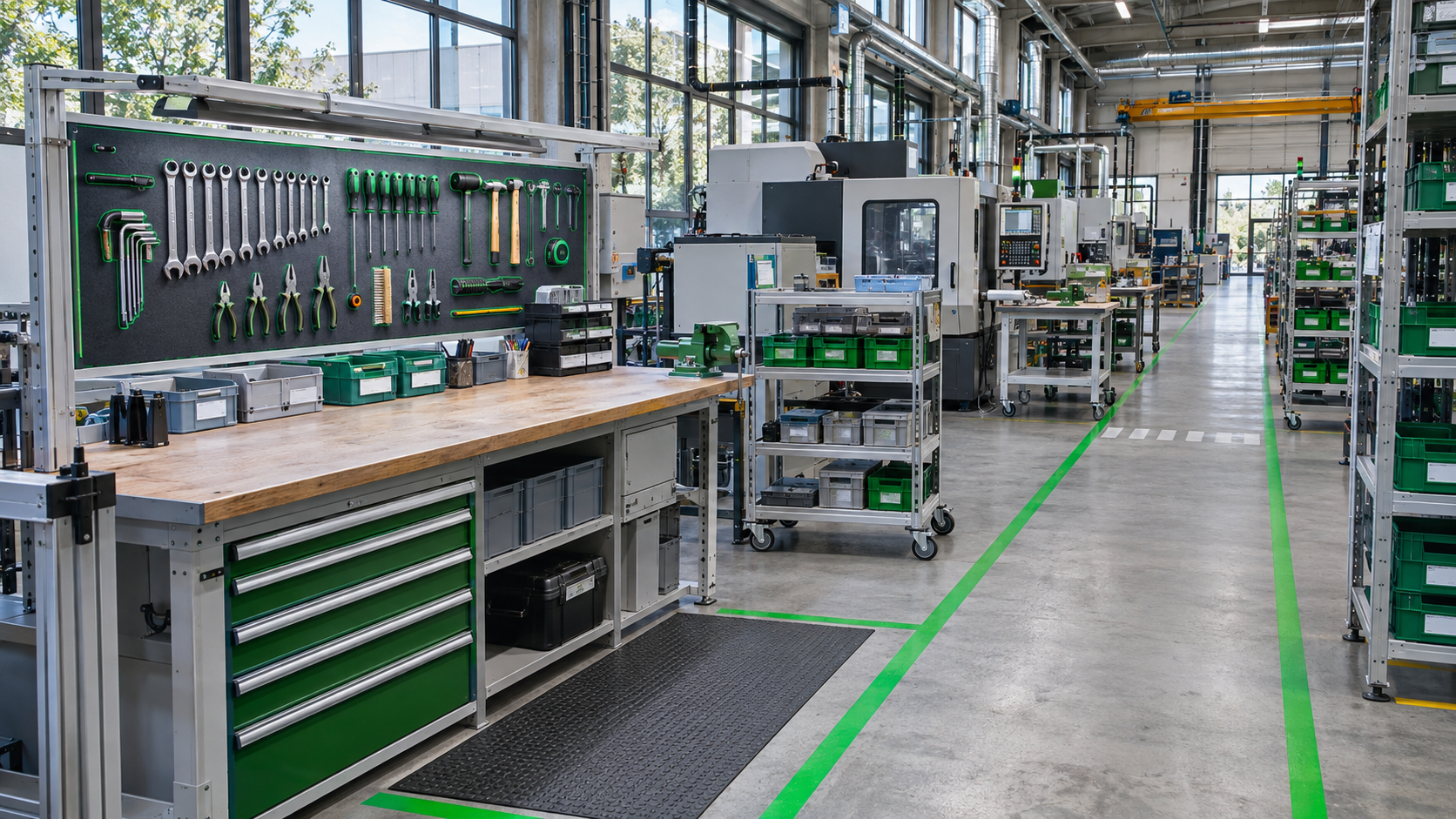
Why tidying up is not enough
Before a customer visit, the factory is cleaned, tools are arranged and aisles are cleared. Everything looks good, but a few weeks later it is back to the way it was. That is hardly surprising if nobody has addressed why material ends up in the aisle or why tools have no assigned location.
Order matters, but it is not proof of a better process. A marked pallet location will not help if it is too far from where the material is used. A photo of a tidy bench will not solve a lack of safe working space. With 5S, we need to observe how people actually work and what makes their tasks harder.
1. Seiri – separate what is needed from what is not
Start with everything already at the workstation: tools, accessories, materials, documents, spare parts and items left over from earlier jobs. For each item, establish what it is for, how often it is used and whether it needs to be there.
A tool used in every cycle has a different priority from an accessory needed once a month. Keeping everything “just in case” quickly fills the work surface and makes essential items harder to find.
Items whose purpose is unclear can be temporarily tagged and set aside. Assign someone to check whether they are needed and set a decision deadline. Setting an item aside is not permission to throw it away: measuring equipment, safety equipment and documents must be moved or disposed of in accordance with the applicable rules.
2. Seiton – arrange items around the work
Once unnecessary items have been separated, decide where everything belongs. The layout should follow the sequence of operations and frequency of use, with safe reach and enough working space.
- Keep frequently used tools close to where they are used.
- Mark locations so that a missing tool is immediately obvious.
- Separate incoming material, finished products and parts awaiting a quality decision.
- Define how much material is needed at the workstation and how it will be replenished.
- Keep aisles clear and maintain access to equipment that must remain accessible.
Labels should make sense to someone from another shift or someone learning the job. If they have to ask where an item belongs, the layout or labelling is not yet clear enough.
3. Seiso – clean and inspect
Cleaning is an opportunity to spot what clutter can hide: oil leaks, damaged cables, loose connections, worn supports or deposits that affect product quality.
If oil appears under a machine every day, wiping the floor only deals with the symptom. Report the leak, assign an owner and remove the cause. The same applies to dust, material offcuts and damaged packaging that keep returning to the workstation.
Agree what is cleaned, when, with what and by whom. Work on machinery must follow safe working instructions and the required isolation of energy sources. Tidiness never justifies reaching into unguarded or operating equipment.
4. Seiketsu – agree a standard people can maintain
A good standard clearly shows how the workplace should look and what needs to be done to keep it that way. It may be a photo with marked locations, a simple tool layout or a short start-of-shift and end-of-shift checklist.
The standard should also explain what to do when something is missing or faulty. Who replenishes material? Who receives reports of damaged measuring equipment? Who decides what happens to parts set aside because of suspected quality problems? Without these answers, marked locations soon become empty outlines.
The people working at the station should help develop the standard. They know what needs to be within reach, where congestion occurs and which proposed locations are impractical.
5. Shitsuke – sustain the agreed way of working
The hardest part comes after the initial reorganisation. Every shift needs to use the new layout, new employees need to learn the rules, and the standard needs updating when products, equipment or working methods change.
Brief, regular checks help sustain the agreement. Their purpose is to identify and resolve problems, rather than simply record a score. If the same deviation keeps recurring, check whether the rule is practical, whether the necessary conditions exist and whether someone is responsible for responding.
What this looks like at one workstation
Consider an assembly and final inspection station. Spanners are kept in a shared drawer, inspection equipment is on another bench, and accepted parts sit beside parts of uncertain status. Each shift arranges the space slightly differently.
First, remove unnecessary accessories. Arrange tools in the sequence of work, and give inspection equipment a dedicated location with protection against damage. Physically separate parts awaiting inspection from accepted products and label their status clearly. Agree material replenishment and shift handover arrangements with the team.
After a trial, check whether the layout works. A rack may be tidy, but if the operator has to turn around for a tool in every cycle, it needs moving. Confirm the standard only after seeing that it works in practice.
How to tell whether 5S has improved the work
Before-and-after photos are useful, but they do not tell the whole story. We can compare the following before and after the change:
- time spent finding and preparing tools
- trips to collect material during the job
- workstation setup or changeover time
- material mix-ups and errors in selecting parts
- recurrence of deviations found during checks
- reported difficulties with reaching, movement and safe working.
Start with a few measures linked to the problem being addressed. If the project began because people were searching for tools, measure whether searching has decreased. A high tidiness score means little if employees still lose the same amount of time.
What managers need to provide
Employees cannot maintain a standard without suitable shelves, containers, time and support in resolving reported problems. Managers need to provide the right conditions, follow up agreed actions and apply the same rules consistently.
Not every improvement requires investment. Moving tools, removing unnecessary material or separating product statuses more clearly can often be tested straight away. When a new rack or a modified bench is needed, link the investment to a specific problem.
From one workstation to a daily habit
Start with a small area where there is a clear problem. Review the situation with the people working there, agree changes and test them. Check the results, refine the layout and make what works the standard. This is the practical link between 5S, PDCA and continuous improvement.
Successful 5S is visible in everyday work: tools are available when needed, material does not get in the way, product status is clear and problems are easy to spot. That workplace is easier to maintain and hand over to the next shift.
For help with introducing 5S, organising workstations and practical employee training, explore our training courses and workshops.
