
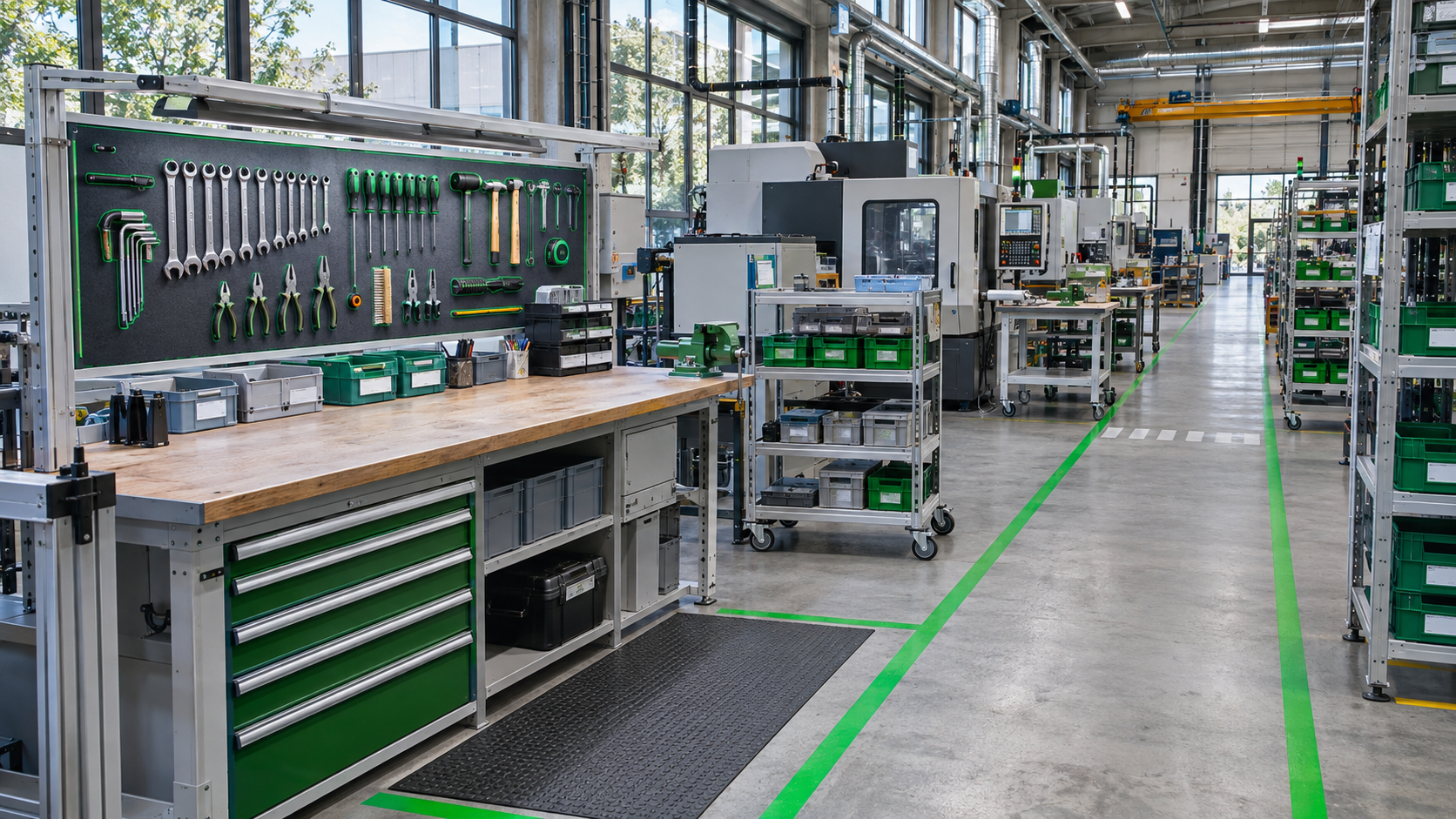
Methods and tools
Successful improvement takes deliberate work.
Results come from a systematic approach, clear working methods and ongoing process monitoring.
At Lean & Smart, we use proven Lean and organisational methods to help companies improve productivity, reduce waste and make better decisions based on reliable data.
Our focus is on applying these tools in everyday production and business operations.
Together, we assess the current situation, identify areas for improvement and introduce methods that provide:
- greater process visibility
- clearer responsibilities
- more consistent results
- faster decisions
- better resource and capacity management
- less downtime, fewer errors and fewer unnecessary activities
We adapt our methods to each organisation, taking account of its processes, the maturity of its systems and the specific objectives it wants to achieve.
We commonly use:
- visual management
- KPI monitoring
- process standardisation
- 5S workplace organisation
- root cause analysis
- process and value stream mapping
- capacity planning and progress tracking
- Lean workshops and continuous improvement
We aim to build a simple, effective way of working that makes daily tasks easier for employees and gives management a clear view of the business.
Tools
Managing production and business processes successfully takes more than experience and intuition.
Consistent, measurable results require practical tools for analysing processes, identifying problems and improving how work is done.
We use proven Lean, organisational and analytical tools applied in manufacturing, logistics, quality and project management.
These tools help us achieve:
- better process visibility
- less waste and downtime
- clearer ownership of responsibilities
- faster decisions
- better work organisation
- higher productivity and more stable processes
We adapt the tools to the organisation’s actual situation and process maturity, keeping the focus on practical use and measurable results.
Tools we commonly use
5S workplace organisation
A method for organising the workplace through sorting, standardisation and sustained order to improve efficiency and safety.
KPI systems and performance monitoring
Defining key performance indicators and tracking results through visual displays and data analysis.
Visual management
Using visual tools to monitor processes, production status, downtime, quality and progress towards objectives.
Process standardisation
Developing clear procedures, work instructions and standards to make processes stable and repeatable.
OEE analysis
Monitoring overall equipment effectiveness through availability, performance and production quality.
Root cause analysis
Using methods such as:
- 5 Whys
- Ishikawa diagrams
- Pareto analysis
- Root Cause Analysis (RCA)
to identify the underlying causes of problems, rather than address symptoms alone.
Value Stream Mapping (VSM)
Mapping the value stream and analysing processes to identify waste and bottlenecks.
The Kaizen approach
Continuous improvement through small, sustained changes and employee involvement.
Capacity management and production planning
Monitoring production loads and resource availability to improve planning.
Downtime monitoring and loss analysis
Setting up downtime recording, analysing the causes and defining corrective actions.
Lean management tools
Applying Lean principles to reduce activities that do not add value.
MRP / ERP systems
Support in implementing and organising systems for resource, material and production planning.
Project management
Tracking project delivery through:
- schedules
- budgets
- resources
- KPIs
- reviews of progress against objectives
SWOT and PESTLE analysis
Assessing the internal and external factors that influence business performance and organisational development.
Dashboards and reporting systems
Creating clear, straightforward reports to track objectives and support decisions.
Process digitalisation
Support in moving from manual records to digital process and data monitoring.
Every organisation needs an approach suited to its circumstances.
We select and adapt tools around the actual needs of the process, the people doing the work and the objectives the organisation wants to achieve.
