
Is external quality inspection at your supplier worth it?
When is external inspection an investment, and when is it an unnecessary cost?
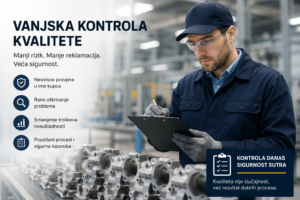
Rising customer expectations, more complex supply chains and tighter delivery deadlines are leading many organisations to consider external quality inspections at their suppliers.
The question is usually whether an additional check of products and processes is worth the cost before the goods reach the customer or the organisation’s own production line.
The answer depends on the circumstances.
In some cases, external inspection adds unnecessary cost. In others, it can prevent losses many times greater than the inspection fee.
What is external quality inspection?
External quality inspection means appointing an independent specialist or inspection company to act on the customer’s behalf. The scope can include production process reviews, pre-shipment inspection, first-batch inspection, process audits, verification of corrective actions, checks of packaging, labelling and documentation, stock verification, production monitoring during critical projects, and reporting on the actual situation at the supplier.
The inspector or team acts as the customer’s local representative, providing an independent assessment before the product leaves the supplier’s facility.
When does external inspection make sense?
External inspection is particularly useful when:
- you are introducing a new supplier
- a new product or production line is being launched
- customer complaints occur frequently
- the product has high added value
- a quality issue could stop the customer’s production
- the supplier is based in another country
- your own team lacks the capacity for regular inspections
- a material or process change creates additional risk
- a customer or certification audit is approaching
- the customer requires extra assurance before shipment.
When is additional inspection unnecessary?
External inspection is not always the best option.
If the process is stable, the supplier has performed well for years, complaints are rare and the quality system works reliably, additional inspection may add unnecessary cost.
In those circumstances, occasional process audits and periodic checks may be sufficient.
Benefits of external quality inspection
An independent partner can provide:
- an objective assessment of the actual situation
- early detection of problems
- fewer customer complaints
- a lower risk of shipping defective products
- greater confidence before shipment
- technical support in discussions with the supplier
- better reporting to management
- faster implementation of corrective actions
- less pressure on internal resources
- better oversight of critical projects.
Potential drawbacks
Like any service, external inspection has its limitations.
Common challenges include:
- additional costs
- the need for effective communication between all parties
- clearly defining responsibilities
- possible supplier resistance to additional inspection
- finding competent, experienced inspectors.
When the service is planned carefully and targeted at the right risks, the benefits will usually outweigh these drawbacks.
How do you assess the financial case?
A common mistake is to look only at the inspection fee.
The more useful question is:
What does one serious customer complaint cost?
For example:
The cost of a complaint may include:
- expedited freight
- additional sorting
- replacement products
- employee time
- downtime at the customer’s plant
- contractual penalties
- additional internal inspections
- damage to the customer relationship
- loss of future business.
A single complaint can cost tens of thousands of euros.
Periodic or ongoing external inspection may cost only a fraction of that amount.
An illustrative cost comparison
Suppose an organisation makes 600 shipments a year and has one serious customer complaint annually, with an average cost of €20,000. External quality inspection would cost €600 a month. The following simplified comparison assumes that inspection prevents that complaint.
Without external inspection
- Complaint cost: €20,000
- Inspection cost: €0
- Total annual cost: €20,000
With external inspection
- Complaint cost: €0
- Inspection cost: €7,200
- Total annual cost: €7,200
In this simplified example, the potential saving is almost €13,000 a year, with substantially lower business risk.
Every organisation has different processes. The principle is to compare the cost of prevention with the potential cost of poor quality.
How should you decide?
Before deciding, consider these questions:
- What is the actual risk of a customer complaint?
- What could one complaint cost us?
- Do we have enough internal resources?
- How often do we visit our suppliers?
- How much confidence do we have in the current inspection system?
- What would a stoppage at the customer’s plant cost us?
- Can we afford one serious error?
The answers will usually make it clear whether additional inspection makes economic sense.
Conclusion
External quality inspection cannot solve every problem, but in the right circumstances it can be one of the most cost-effective preventive measures an organisation adopts.
Early detection of nonconformities, independent process assessment and effective supplier communication can substantially reduce the risk of complaints, production stoppages and unplanned costs.
Successful organisations invest in inspection because they understand how expensive it can be to discover a problem too late.
Quality is built through stable processes, timely checks and decisions based on facts. Final inspection alone cannot create it.
Considering external quality inspection, or want to assess whether it would pay off? Contact Lean & Smart for an independent process assessment, a supplier audit or inspections carried out on your behalf.
