
OEE – when it makes sense and when it does not
OEE (Overall Equipment Effectiveness) is one of the best-known manufacturing metrics. It is often used as the main KPI for measuring production effectiveness.
Many companies introduce OEE to improve productivity, reduce losses and manage capacity more effectively. In practice, though, it is often tracked without a clear understanding of what it measures or when it is useful.
The result is a KPI that appears in reports but adds little value to production management.
What is OEE?
OEE measures overall equipment effectiveness through three components:
Availability
The proportion of planned production time during which the equipment actually runs.
It captures losses such as:
- breakdowns
- stoppages
- machine setup
- waiting for materials
- organisational delays
Performance
How fast the process runs compared with its ideal speed.
Examples of losses include:
- running below the standard rate
- short stoppages
- micro-stops
- reduced production speed
Quality
The proportion of produced units that meet requirements.
This includes:
- scrap
- rework
- customer complaints
- defective products
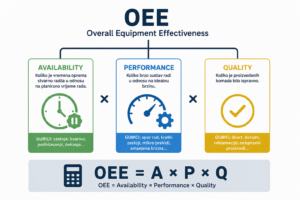
The formula is:
OEE = Availability × Performance × Quality
OEE=Availability×Performance×QualityOEE = Availability \times Performance \times Quality
When is OEE useful?
OEE is useful when an organisation wants to understand its actual process losses and identify the biggest opportunities for improvement.
It usually works well where there are:
- stable, repetitive production processes
- defined standard times
- clearly defined capacities
- automated processes
- reliable downtime data
Examples include:
automotive manufacturing
glass manufacturing
packaging
food manufacturing
automated production lines
In these settings, OEE can help identify the real causes of losses.
When is OEE less useful?
Problems arise when OEE is applied everywhere without considering how the process works.
OEE is often less suitable in the following situations:
High product mix and small batches
With many different products and frequent setups, OEE can look poor even when the process is performing as expected.
Labour-intensive processes
When performance depends more on people than on equipment, labour productivity, output per working hour or takt-based measures may be more useful.
Unreliable data
Without accurate downtime records, standards and capacity data, OEE becomes unreliable.
Undefined time standards
Without a defined ideal cycle time, the performance figure becomes an estimate.
Common mistakes when introducing OEE
Many organisations make the same mistakes:
- OEE becomes the only KPI
- only the overall percentage is tracked
- the causes of losses are not recorded
- there are no action plans
- data is collected manually and unreliably
- the focus shifts to raising the number instead of removing the cause
For example:
A production line has an OEE of 55%.
If we do not know whether the main problem is:
breakdowns
waiting for materials
slow running
scrap
then OEE gives us a number, with little insight into what to do next.
What should you track alongside OEE?
To make OEE useful, it often needs to be connected with other KPIs:
- output per labour hour
- downtime and its causes
- OTD (On-Time Delivery)
- scrap %
- tool changeover time
- capacity utilisation
- planned versus actual output
OEE should connect with other performance indicators, rather than replace them.
Conclusion
OEE can be a powerful production management tool when it is based on sound process knowledge and reliable data.
OEE is not a goal in itself.
Rather than asking only:
“What is our OEE?”
we should also ask:
“Where are our biggest losses, and what do we need to improve?”
Used well, OEE helps an organisation understand its processes, reduce losses and make better decisions. Used poorly, it becomes just another KPI in a report.
